The Seven Species in Deuteronomy 8:8
Updated November 29, 2026
אֶרֶץ־זֵית שֶׁמֶן וּדְבָשׁ“A land of oil olives and honey”
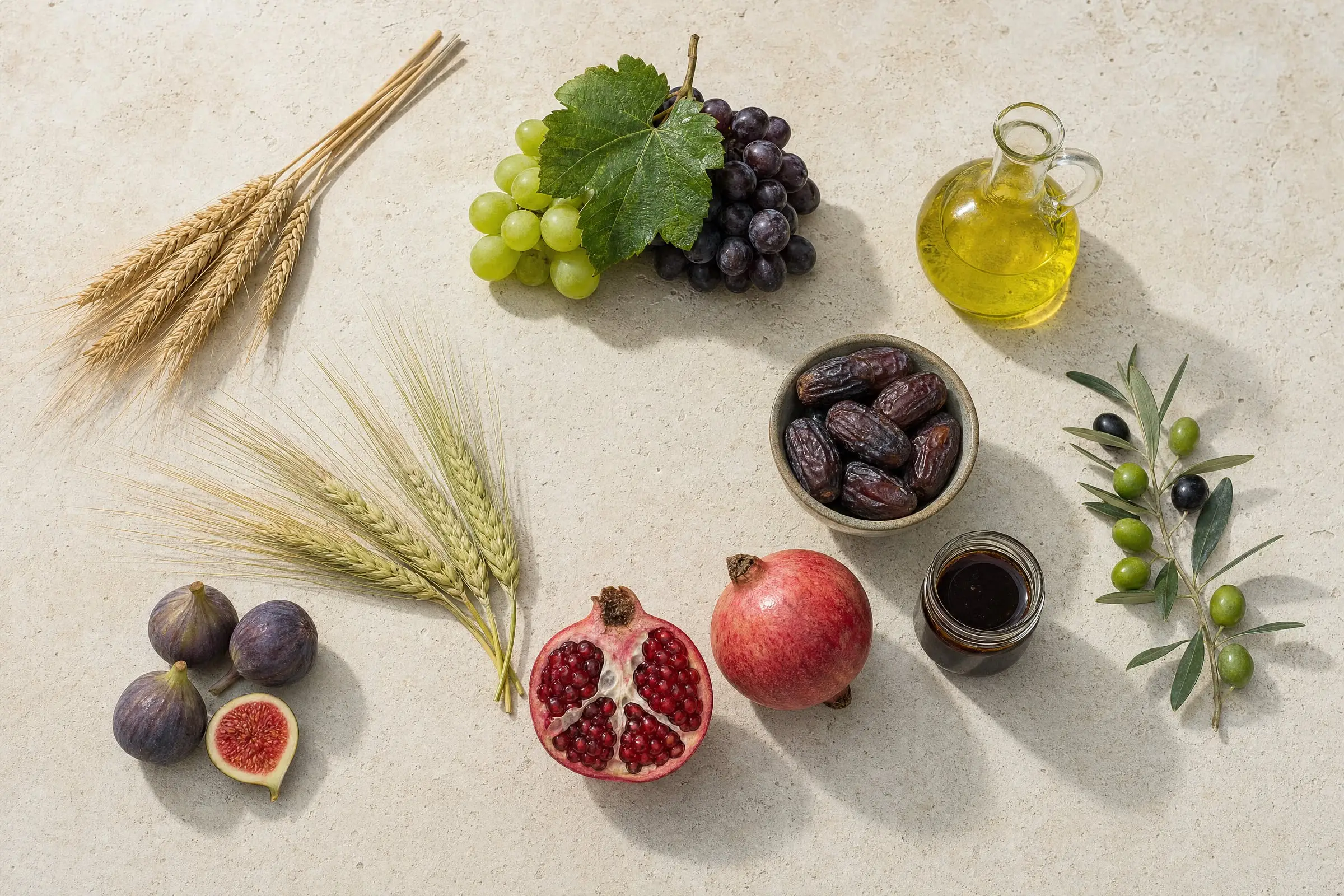
One verse praises the land by naming what grows in it. The Sages read the list closely. They drew from it a rule for first fruits, an order for blessings and, in one teaching, a set of measures. Here is the verse, and then each species in the field.
The verse
Moses describes a good land, with streams, springs and deep waters that rise in valley and hill (Deuteronomy 8:7). The next verse names its produce.
אֶרֶץ חִטָּה וּשְׂעֹרָה וְגֶפֶן וּתְאֵנָה וְרִמּוֹן אֶרֶץ־זֵית שֶׁמֶן וּדְבָשׁ
“A land of wheat and barley, vine and fig and pomegranate, a land of oil olives and honey.”
Deuteronomy 8:8
The word “land” comes twice. Five species follow the first, and two follow the second. Rashi reads the olives here as olives that give oil. As for the honey, Rashi on Deuteronomy 26:2, citing the Sifrei, writes that it is the honey of dates.
Honey from the date
The word honey does not always point to dates. The Mishnah rules that one who vows to abstain from honey is still permitted date honey (Nedarim 6:9). In the language of vows, plain honey meant something else.
The phrase “flowing with milk and honey” is read in a similar way. Rashi on Exodus 13:5 says that the milk flows from goats, and the honey from dates and figs. In Ketubot 111b, Rami bar Yechezkel comes to Bnei Brak and sees goats grazing under fig trees. Honey drips from the figs, milk runs from the goats, and the two mingle. This, he says, is the meaning of a land flowing with milk and honey.
First fruits
Rashi on Deuteronomy 26:2 states that first fruits come from these seven species alone, and learns it from the word “land” in both places. The Mishnah gives the same limit and then narrows it: no dates from the hills, no produce from the valleys, and no oil olives short of the choice ones (Bikkurim 1:3). The moment of setting them aside is simple.
יוֹרֵד אָדָם בְּתוֹךְ שָׂדֵהוּ וְרוֹאֶה תְּאֵנָה שֶׁבִּכְּרָה, אֶשְׁכּוֹל שֶׁבִּכֵּר, רִמּוֹן שֶׁבִּכֵּר, קוֹשְׁרוֹ בְגֶמִי, וְאוֹמֵר, הֲרֵי אֵלּוּ בִּכּוּרִים
“A person goes down into his field and sees a fig that has ripened first, a cluster that has ripened first, a pomegranate that has ripened first. He ties it with a reed and says: These are first fruits.”
Mishnah Bikkurim 3:1
Rabbi Shimon adds that he must name them again once they are picked.
Order and measure
In Berakhot 41a, Rav Yosef, or some say Rabbi Yitzchak, teaches that what comes earlier in this verse comes earlier for a blessing. The Gemara tells of Rav Chisda and Rav Hamnuna at a meal, with dates and pomegranates before them. Rav Hamnuna blessed the dates first. Rav Chisda pointed to the verse, where the pomegranate comes before the honey. Rav Hamnuna answered that the date stands second after the word “land,” while the pomegranate stands fifth (Berakhot 41b).
Rabbi Chanan hears the verse differently: all of it was said for measures. The Gemara pairs each species with one.
- Wheat: the time it takes to eat half a loaf of wheat bread, in the law of one who enters a house struck with tzaraat.
- Barley: a bone the size of a barley grain.
- Vine: the quarter log of wine for a nazirite.
- Fig: the bulk of a dried fig, for carrying out on Shabbat.
- Pomegranate: a hole the size of a pomegranate, in household vessels.
- Olive: a land whose measures are the size of an olive, says Rabbi Yose son of Rabbi Chanina. The Gemara takes this to mean most of them.
- Honey: a large date, the measure for Yom Kippur.
How any of this applies in practice is a question for your own rabbi.
In the field
A small limestone tablet found at Gezer, dated by its script to the tenth century BCE, lists the farming year. On an accepted reading, it opens with two months of fruit picking, mainly olives. Sowing, flax, barley, wheat and the vines follow. It ends with summer fruit, the figs. Scholars disagree about the tablet’s purpose.
- Wheat suits a cool, wet winter followed by a dry spring.
- Barley ripens ahead of wheat. In Egypt the hail struck the barley, which was in the ear, and spared the later wheat (Exodus 9:31-32). In biblical times barley was the poorer person’s grain.
- The vine stays green through the dry heat of late summer, as its grapes ripen.
- The fig drops its leaves in winter. Small green figs begin to form at winter’s end and keep growing through the summer.
- The pomegranate opens large red flowers in spring.
- The olive blossoms at the start of summer. Its fruit ripens around the first rains of October.
- The date palm needs heat. It fruits in hot lowlands and desert plains, and gives no edible fruit in the hills.
For the date that begins a tree’s year, read Tu BiShvat in the Mishnah. For the blessing of oil, read Asher and the Galilee. See also a sample holding of olives in the Galilee.
Sources
- Deuteronomy 8:7-8: the verses and their Hebrew.
- Rashi on Deuteronomy 8:8: olives that give oil.
- Rashi on Deuteronomy 26:2: first fruits from the seven species alone, and date honey.
- Rashi on Exodus 13:5: milk from goats, honey from dates and figs.
- Mishnah Nedarim 6:9: honey in the language of vows.
- Mishnah Bikkurim 1:3 and 3:1: which produce is brought, and how it is marked in the field.
- Berakhot 41a and 41b: the order of blessings and the measures.
- Ketubot 111b: the goats and fig trees of Bnei Brak.
- Exodus 9:31-32: barley ahead of wheat.
- Gezer Calendar, Encyclopaedia Judaica: the tablet and its farming year.
- The Seven Species, Israel Ministry of Foreign Affairs: wheat, barley and the vine.
- Fig, Pomegranate, Olive and Palm, Encyclopaedia Judaica: how each tree grows.
Quotations are given in Hebrew with their references; translations are plain renderings unless stated. This page reports what texts say and what is known about places. It gives no halachic ruling and no legal advice.